
Gaps That Often Appear Between Health and Disability Insurance
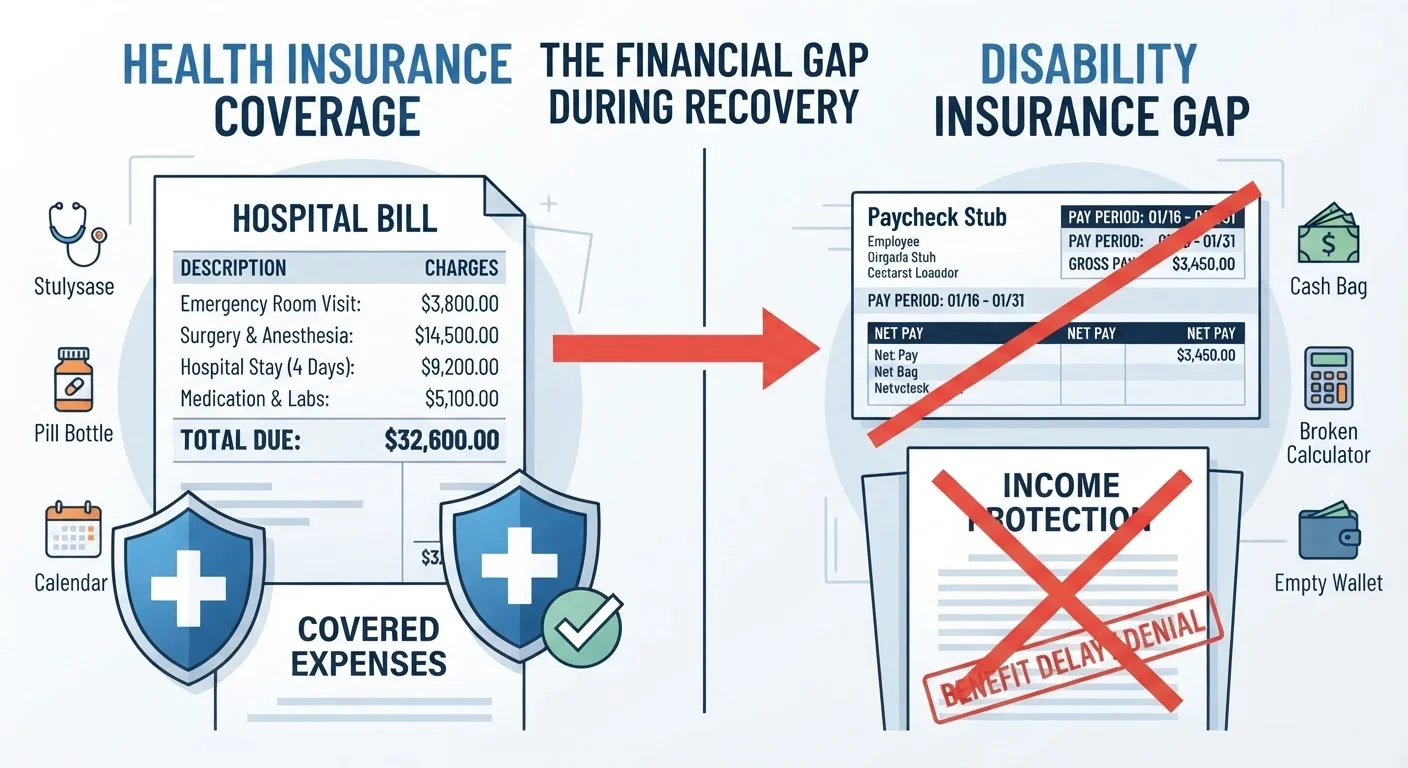
Photo credit: Wiseturt.com | Blogs Curated For You
In this article
Health insurance covers medical bills; disability insurance covers lost income. Understanding where one ends and the other begins matters more than most people realise.
Key Takeaways
- Health insurance pays medical providers; disability insurance replaces a portion of your lost income.
- Most employer health plans do not include any disability income protection by default.
- Short-term and long-term disability policies have different waiting periods and benefit durations.
- Serious illnesses can trigger both types of coverage needs simultaneously, yet gaps still remain.
- Reviewing both policies together - not in isolation - helps identify where you may be exposed.
What Each Type of Insurance Actually Covers
The confusion between health and disability insurance is understandable - both are triggered by illness or injury, and both involve the word "insurance." But they protect against fundamentally different financial losses.
Health insurance pays the providers who treat you: doctors, hospitals, labs, pharmacies. It reduces or eliminates what you owe for covered services, subject to your deductible, copays, and out-of-pocket maximum. It does not care how long you are out of work or whether your income drops to zero.
Disability insurance does the opposite. It does not pay your medical bills. Instead, it replaces a percentage of your pre-disability income - typically 60-70% - when an illness or injury prevents you from working. The coverage kicks in after a waiting period (called an elimination period) and pays out for a defined benefit period.
For a broader look at how these fit among other coverage types, see the major types of insurance and what each one protects.
| Health Insurance | Disability Insurance | |
|---|---|---|
| What it pays for | Medical bills and treatment costs | A portion of lost income |
| Triggered by | Use of medical services | Inability to work due to illness or injury |
| Waiting period | Generally none (subject to deductibles) | Elimination period: 7 days to 90+ days |
| Benefit duration | Ongoing while enrolled and paying premiums | Weeks to years depending on policy type |
| Income replacement | None | Typically 60-70% of pre-disability income |
| Common employer provision | Widely offered as a standard benefit | Short-term common; long-term less consistent |
The Gaps That Catch People Off Guard
Understanding what each policy does is only the start. The real risk lies in assuming the two together form a seamless safety net - they often do not.
Don't Assume Health Coverage Equals Income Protection
A common misconception is that comprehensive health insurance provides a financial safety net if you become seriously ill. It does not replace your paycheck. Medical bills may be covered, but rent, groceries, and loan payments are not. Workers who rely solely on health insurance and savings are often surprised by the income exposure a prolonged illness creates.
The Elimination Period Gap
Most short-term disability policies begin paying after 7-14 days; long-term policies commonly carry a 90-day elimination period. If you have no short-term coverage and your long-term policy's clock hasn't started paying, you may have weeks or months of zero income replacement - even while health insurance continues covering your treatment.
The Income Cap Gap
Employer group disability plans often cap monthly benefits at a fixed dollar amount that may not reflect your actual salary. High earners and self-employed workers are particularly exposed here.
The Definition-of-Disability Gap
Some policies only pay if you cannot perform any occupation. Others use an own-occupation definition, which is more favourable - it pays if you cannot perform your specific job. Understanding which definition your policy uses matters enormously. This is the kind of fine print explored further in things your insurance policy likely does not cover.
The Mental Health and Chronic Illness Gap
Some disability policies limit benefits for mental health conditions or certain diagnoses to 24 months, even when the underlying health insurance has no such restriction. The two policies may handle the same condition very differently.
Short-Term vs. Long-Term Disability: How They Compare
Disability insurance itself is not monolithic. Short-term and long-term policies serve different roles, and many workers have one without the other.
1 in 4
Workers who will experience a disability before retirement
According to the Social Security Administration, roughly one in four 20-year-olds will experience a disability lasting 90 days or more before reaching retirement age.
60-70%
Typical income replacement from disability insurance
Most group and individual disability policies replace between 60% and 70% of pre-disability gross income, leaving a meaningful income gap for many claimants.
Short-term disability is designed for recoverable conditions - a broken leg, surgery recovery, or a difficult pregnancy. It typically pays for 3-6 months. Long-term disability picks up after that, covering extended or permanent inability to work, sometimes until retirement age.
The gap between the end of short-term benefits and the start of long-term benefits - if the elimination periods don't align - can leave workers without income for a critical stretch. This structural overlap issue is one reason that insurance myths that lead people to buy the wrong coverage so often involve disability coverage specifically.
How to Assess Your Own Coverage Position
Evaluating where you stand requires looking at both policies side by side, not separately. A few practical questions to work through:
- Does your employer offer disability coverage? If so, what percentage of income does it replace, what is the elimination period, and what is the benefit duration?
- Is your disability coverage taxable? Employer-paid premiums typically mean benefits are taxed as ordinary income - which can meaningfully reduce what you actually receive.
- What is your liquid emergency fund? Savings can bridge elimination period gaps; without them, even a short coverage gap is financially disruptive.
- Are there exclusions for pre-existing conditions? Some individual disability policies exclude conditions you had before applying.
The relationship between what you pay for coverage and what you actually receive is also worth understanding. Deductible vs. premium trade-offs apply to health insurance in ways that can affect how much out-of-pocket exposure you carry alongside a disability event.
This article is for general informational purposes only and does not constitute personalised insurance or financial advice. Coverage terms, eligibility, and benefit structures vary significantly by policy and provider. Consult a licensed insurance professional to evaluate your specific situation.

Author
Investment & Insurance Editorial Team
Investment & Insurance Editorial Team is the collective byline for our editorial team and contributor network. Articles published under this byline or an editorial pen name are researched, written, and reviewed according to our editorial standards for clarity, consistency, and independence before publication.
View all articles →