
Time Management Myths That Keep Employees Busy But Unproductive
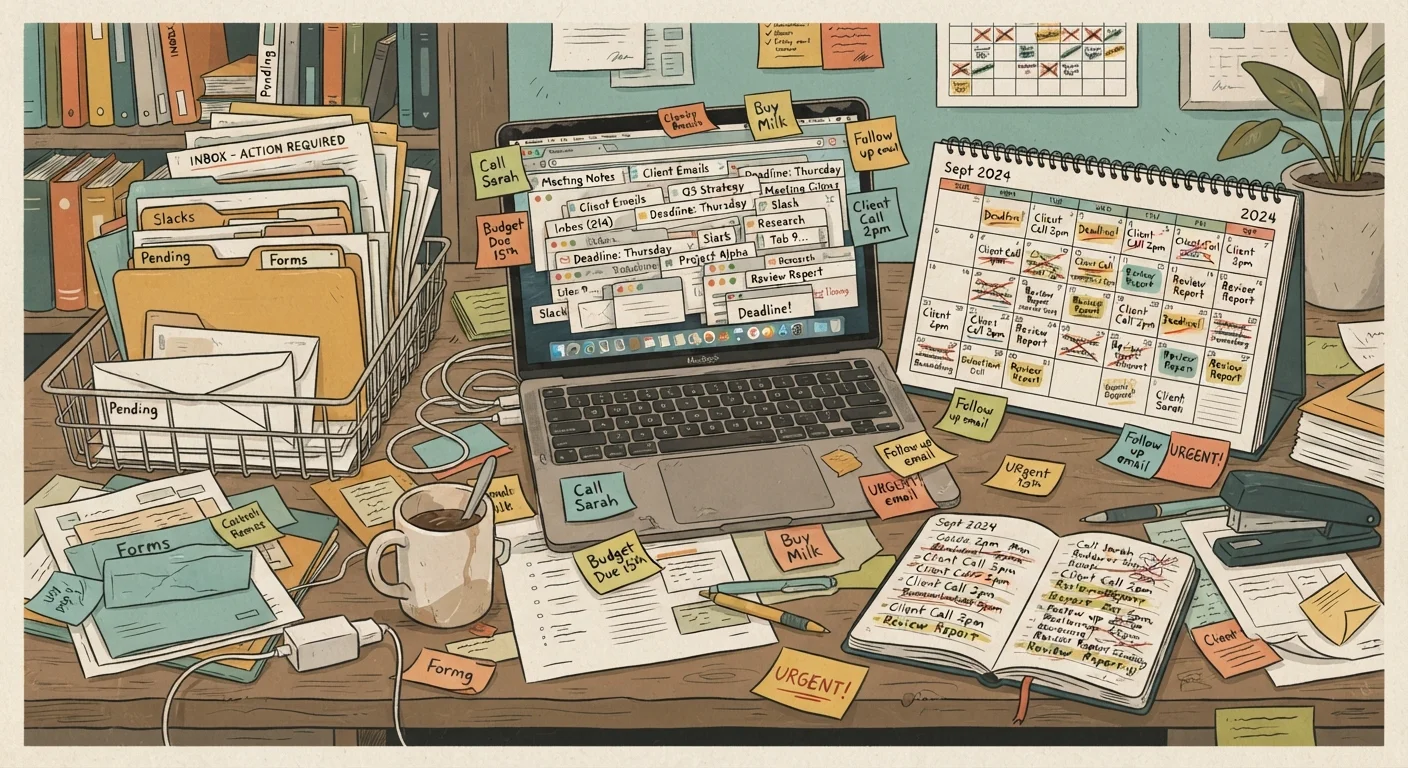
Photo credit: Wiseturt.com | Blogs Curated For You
In this article
Multitasking, inbox zero, and packed calendars are often sold as productivity wins. Here's what the evidence actually says about managing time at work.
Key Takeaways
- Multitasking consistently reduces work quality and increases errors, according to cognitive research.
- A packed calendar signals busyness, not effectiveness - protecting unscheduled time improves output.
- Inbox Zero is a maintenance habit, not a productivity strategy; it can consume more time than it saves.
- Working longer hours has diminishing returns; output quality typically drops after about 50 hours per week.
- Time management is a skill built through deliberate practice, not a fixed personality trait.
Why These Myths Persist - and Who Pays the Price
Time management advice is everywhere, yet chronic overwork and burnout remain common workplace complaints. The disconnect often traces back to persistent myths about what productivity actually looks like. Many of these beliefs are well-intentioned - they evolved in industrial-era workplaces where visible effort equaled output. But in knowledge-based roles, the relationship between hours spent and value produced is far less direct.
The cost isn't just personal. Research from organizations like the American Institute of Stress has consistently linked overwork to reduced decision-making quality, higher absenteeism, and lower team morale. Understanding which widely held beliefs are actually working against you is a practical first step - see the full picture on workplace productivity for a broader look at the habits and systems that support sustained performance.
Myth
Multitasking makes you more productive by getting more done simultaneously.
Fact
Multitasking typically reduces the quality and speed of both tasks - what most people experience is rapid task-switching, not true parallel processing.
Cognitive science research, including landmark studies from Stanford University, has found that heavy multitaskers performed worse on tests of attention, memory, and task-switching than those who focused on one thing at a time. The human brain largely processes complex information sequentially, not simultaneously. Each switch between tasks carries a cognitive cost - sometimes called switching cost - that adds up across a workday. Protecting blocks of uninterrupted focus time is far more effective than attempting to run tasks in parallel.
Myth
A full calendar means you're using your time well.
Fact
Heavily scheduled days often crowd out the deep, strategic thinking that produces the most valuable work output.
Back-to-back meetings create an illusion of productivity while leaving no space for the reflective, focused work that generates real results. Research from Microsoft's WorkLab has shown that consecutive video meetings increase stress markers measurably compared to days with natural breaks. Effective time management includes deliberately protecting unscheduled time - for thinking, prioritizing, and responding to unexpected demands without derailing everything else. A packed calendar is often a symptom of poor boundary-setting, not exceptional output.
Myth
Inbox Zero is a proven productivity system that keeps you on top of your work.
Fact
Inbox Zero is an email maintenance habit. Pursuing it obsessively can consume more time than the clarity it provides is worth.
The original concept, introduced by productivity writer Merlin Mann, was never intended to mean checking email constantly until the inbox is empty. It was about making deliberate decisions about each message rather than using the inbox as a to-do list. In practice, many workers interpret it as a goal requiring frequent monitoring - which research on workplace interruption suggests can take 20 or more minutes to recover from each time focus is broken. Batching email into two or three dedicated time blocks per day tends to protect concentration more effectively than an always-empty inbox goal.
Myth
Working longer hours consistently produces more output.
Fact
Output quality and quantity both decline significantly beyond roughly 50 hours of work per week, making extra hours less effective - and sometimes counterproductive.
A widely cited body of research, including analysis by economist John Pencavel published through Stanford, found that productivity per hour drops sharply after 50 hours per week, and that workers putting in 70-hour weeks produced little more than those working 55. Chronic sleep deprivation - a frequent companion of overwork - impairs judgment, creativity, and emotional regulation. For knowledge workers in particular, the quality of thinking matters more than sheer time at a desk. Sustainable pace, not maximum hours, is what supports long-term performance.
Myth
Some people are just naturally good at managing time - it's a fixed trait.
Fact
Time management is a learnable skill set, not an innate personality characteristic, and it improves with deliberate practice.
Framing time management as a talent some people have and others don't discourages workers from attempting to improve - and it's not supported by evidence. Skills like prioritization, estimating task duration, recognizing decision fatigue, and setting boundaries are all teachable competencies. They develop the same way other workplace skills do: through practice, feedback, and reflection. Attributing poor time management to personality rather than skill also deflects from structural problems - excessive workload, unclear priorities, or meeting cultures - that no individual habit can fix alone.
What Evidence-Based Time Management Actually Looks Like
Replacing these myths with research-backed practices doesn't require overhauling your entire schedule. It starts with a few targeted shifts: prioritizing single-task focus blocks, auditing how much calendar time is genuinely strategic versus reactive, and treating your attention as a finite resource rather than an infinitely renewable one.
40%
Productivity lost to task-switching
Research cited by the American Psychological Association suggests switching between tasks can cost as much as 40% of productive time due to mental switching costs.
50 hrs
Weekly hours beyond which output stalls
Analysis by economist John Pencavel found that output per hour declines sharply beyond 50 work hours per week, with marginal gains disappearing past 55.
23 min
Average refocus time after an interruption
University of California, Irvine researcher Gloria Mark found it takes an average of 23 minutes to fully regain focus after a workplace interruption.
A useful reframe is to evaluate your day by outcomes delivered rather than hours logged or tasks checked off. This matters especially for remote and hybrid workers, where the temptation to signal effort through constant availability can be particularly strong. The same scrutiny applies in broader life decisions - just as evidence-backed wellness habits fit around real schedules, effective time management must be realistic, not aspirational theater.
If you're also re-evaluating other productivity assumptions in your professional life, it's worth noting that job search myths follow similar patterns - effort-intensive activities that feel productive often aren't.
Busyness Can Mask Structural Problems
If your workload genuinely exceeds a reasonable capacity, personal time management techniques will only go so far. Chronic overwork often signals understaffing, unclear role boundaries, or organizational culture issues that individual habits cannot fix. Documenting your time and having a direct conversation with your manager about priorities is more effective - and more sustainable - than simply trying to optimize harder.

Author
Jobs & Careers Editorial Team
Jobs & Careers Editorial Team is the collective byline for our editorial team and contributor network. Articles published under this byline or an editorial pen name are researched, written, and reviewed according to our editorial standards for clarity, consistency, and independence before publication.
View all articles →