
Inside a Dishwasher: How a Full Cycle Actually Cleans Your Dishes
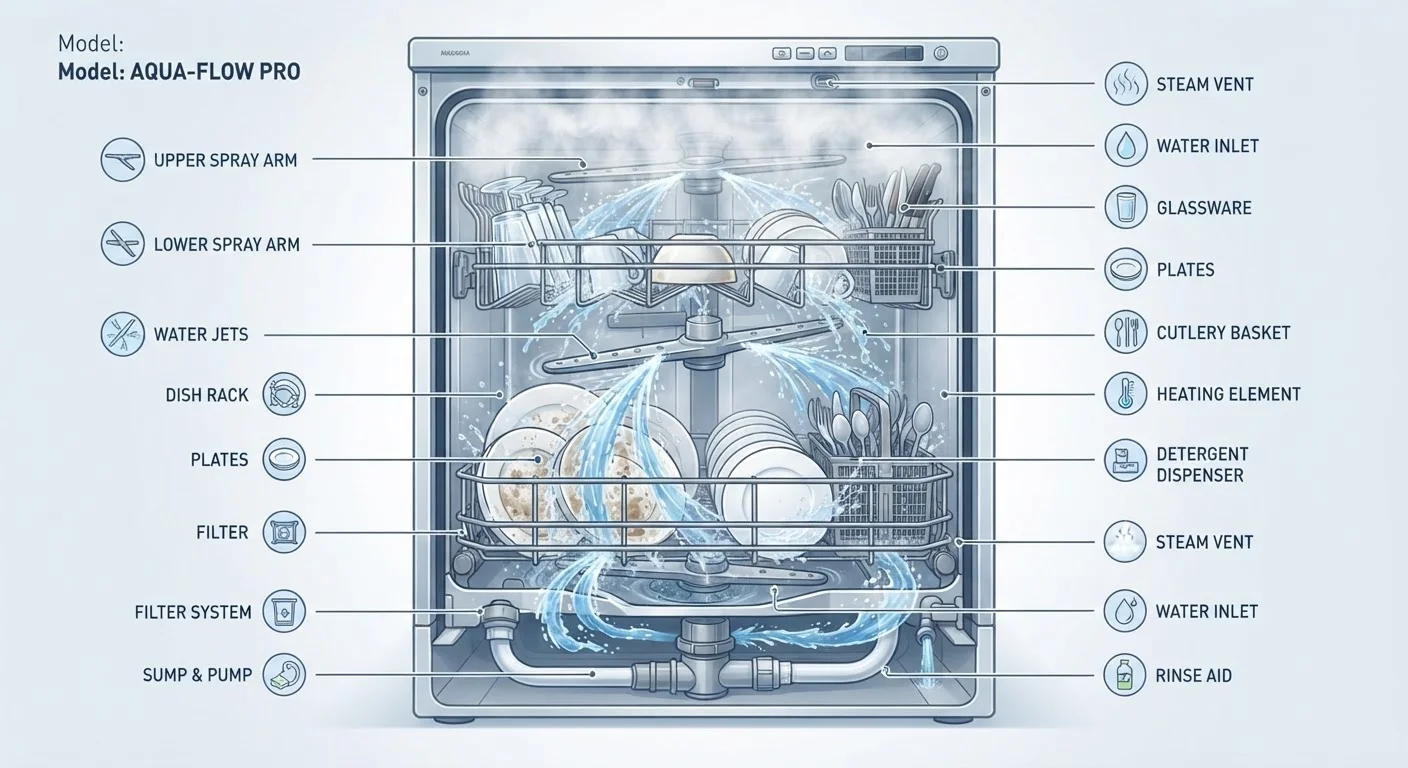
Photo credit: Wiseturt.com | Blogs Curated For You
In this article
A plain-language walkthrough of what happens inside a dishwasher during each phase of a wash cycle, from fill to dry.
Key Takeaways
- A standard dishwasher cycle has four to five distinct phases, each serving a specific cleaning function.
- Detergent is only released during the main wash phase, not at the start of the cycle.
- Spray arms rotate and change direction to reach dishes on both racks.
- Heat and airflow - not just water - are responsible for drying results.
- Understanding each phase helps you load dishes correctly and troubleshoot poor results.
The Phases of a Dishwasher Cycle, in Order
A dishwasher doesn't simply spray water for 90 minutes and stop. Each cycle is divided into timed phases, each performing a specific job. Understanding the sequence makes it easier to load correctly, choose the right cycle, and diagnose problems when dishes come out spotted or still dirty.
Here's what happens from the moment you press start:
- Pre-rinse (or pre-wash): The machine draws a small amount of water and circulates it at lower temperature to loosen and flush away loose food particles. No detergent is used at this stage.
- Main wash: The detergent dispenser opens - usually 15 to 20 minutes into the cycle - releasing detergent into hot water. Spray arms rotate above and below the dish racks, directing pressurized jets at every angle. Water temperature is elevated by the machine's internal heater. This is where the majority of cleaning happens.
- Mid-cycle rinse: The dirty wash water is drained, and fresh water enters to begin rinsing off detergent and loosened food residue. Some cycles run this phase more than once.
- Final rinse: Hot, clean water - often the hottest point of the cycle - flushes the dishes a final time. Rinse aid is dispensed here to reduce water spotting and improve drying.
- Drying: Depending on the machine, drying is achieved through a heated element inside the tub, condensation drying (where residual heat evaporates moisture onto the cooler stainless-steel walls), or a fan-assisted system that circulates warm air.
Load with the spray arms in mind
Dishes should face inward and downward so spray water reaches soiled surfaces directly. Tall items placed on the sides or back of the lower rack can block the spray arms from rotating freely, leaving an entire section of the load underserved. Check that both arms spin without obstruction after loading.
How the Spray Arms and Water System Work
Most dishwashers have two rotating spray arms - one beneath the lower rack and one beneath the upper rack - and sometimes a third fixed spray nozzle at the very top of the tub. Water is pumped from a reservoir at the bottom of the machine up through these arms under pressure.
The arms spin as a result of the water pressure itself, similar to a garden sprinkler. As they rotate, they spray water through dozens of small jets at different angles to reach dishes on all sides. The design assumes dishes are loaded with open surfaces facing inward and downward toward the spray source - which is why loading matters as much as it does.
Sensor-equipped machines use turbidity sensors (which measure how cloudy the water is) to gauge how dirty a load is. The machine then adjusts water temperature, cycle length, and the number of rinse phases accordingly. This is why the same machine can run a 60-minute cycle one day and a 110-minute cycle the next, depending on what's loaded.
Sensor cycles aren't guesswork
Turbidity-based sensor cycles are a standard feature on many mid-range and higher dishwashers. They measure the soil level in the wash water to adjust the cycle automatically. This means running a lightly soiled load through a sensor cycle typically results in a shorter, cooler cycle - which is by design, not a malfunction.
For a broader look at how appliance mechanics affect daily use, see our guide to common appliance myths - including several that specifically involve dishwashers.
What Detergent and Rinse Aid Actually Do
Dishwasher detergent is not the same as hand dish soap. It's formulated to work in a sealed, high-heat environment and typically contains enzymes that break down specific types of food soil - proteases for proteins, amylases for starches, and lipases for fats. These enzymes begin working as soon as they contact food residue in the wash water.
The detergent dispenser is spring-loaded and sealed. It opens automatically partway through the cycle rather than at the start, because the pre-rinse phase would wash it away before the main wash begins.
Rinse aid - dispensed separately from a reservoir, not added manually each cycle - is a surfactant. It reduces water's surface tension during the final rinse so water sheets off dishes in thin films rather than pooling into droplets. Those droplets, when they dry, leave mineral deposits behind as water spots. Rinse aid largely prevents this.
3-4 gallons
Water used per efficient dishwasher cycle
ENERGY STAR-certified dishwashers use approximately 3-4 gallons per cycle, compared to an estimated 20+ gallons typically used for hand-washing the same load.
120°F-160°F
Typical main wash water temperature range
Most dishwashers heat wash water to between 120°F and 160°F depending on the selected cycle; higher temperatures improve grease removal and reduce bacteria.
Understanding how capacity affects detergent use and cycle efficiency is also worth reviewing - our article on appliance load capacity explains how dishwasher size ratings translate to real-world performance.
Why Drying Results Vary - and What Helps
Drying is the phase where dishwashers differ most from each other. Three methods are common in US households:
- Heated dry: An electric heating element at the bottom of the tub heats the air inside. Effective but uses more energy.
- Condensation dry: After the hot final rinse, residual heat on dishes causes moisture to evaporate and condense on the cooler stainless-steel interior walls, where it drains away. Uses no extra energy but leaves plastics wetter.
- Fan-assisted dry: Found in newer models, a fan circulates air to speed evaporation - a middle ground between the two above.
Plastics are consistently harder to dry regardless of the method used, because they don't retain heat as well as glass or ceramic. This isn't a malfunction - it's a material property.
If you're setting up a new kitchen and evaluating which dishwasher features matter most, see what to verify before first use for a practical checklist that covers dishwasher installation and initial settings.
Frequently Asked Questions

Author
Home & Appliances Editorial Team
Home & Appliances Editorial Team is the collective byline for our editorial team and contributor network. Articles published under this byline or an editorial pen name are researched, written, and reviewed according to our editorial standards for clarity, consistency, and independence before publication.
View all articles →