
The Anatomy of a Trustworthy Online Review
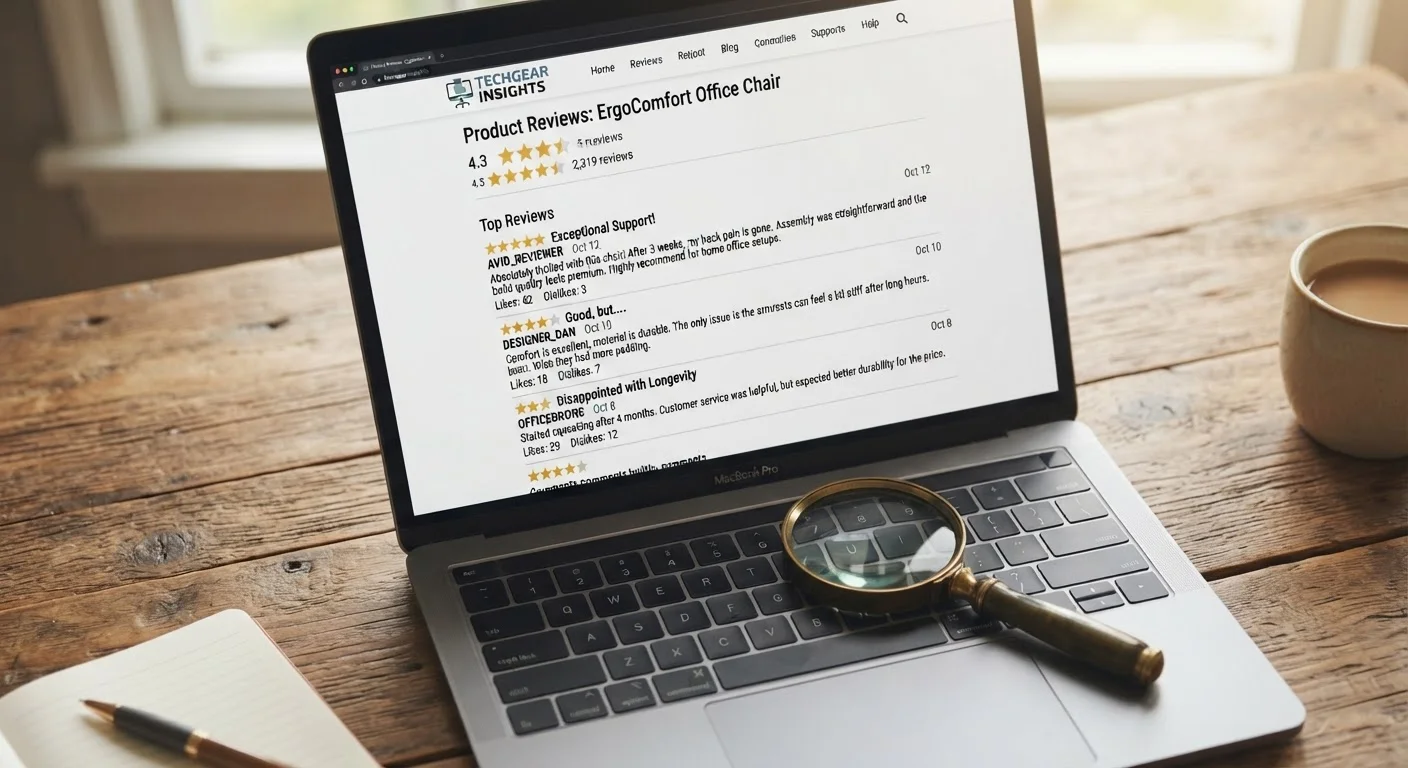
Photo credit: Wiseturt.com | Blogs Curated For You
In this article
Not all reviews are created equal. Learn what separates genuine, useful reviews from paid placements and review farms.
Key Takeaways
- Specific details about use, context, and outcomes are the clearest signal of a genuine review.
- Verified purchase badges improve credibility but do not guarantee an unbiased opinion.
- Clusters of reviews posted within a short timeframe can indicate coordinated or incentivized activity.
- One-word praise or a string of identical phrases across reviews are common hallmarks of review farms.
- Cross-referencing reviews across multiple independent platforms reduces the risk of being misled.
- A trustworthy review often acknowledges both strengths and limitations of a product.
Why Review Quality Varies So Widely
Online reviews exist on a spectrum ranging from meticulous, first-hand accounts to machine-generated text bulk-uploaded by review farms. Between those extremes sit incentivized reviews, competitor attacks, and well-meaning but uninformative one-liners. Understanding that spectrum is the starting point for reading reviews critically.
The review ecosystem is shaped by competing incentives. Sellers want positive visibility; platforms want engagement; some reviewers want free products or commissions. None of these motivations are inherently aligned with giving you accurate information. That does not make all reviews worthless - it means you need a framework for evaluating them rather than taking them at face value.
For a broader look at the assumptions shoppers bring to ratings, see common myths about online ratings - some widely held beliefs about what scores signal are not supported by the evidence.
FTC Rules on Disclosure Apply to Reviewers
The Federal Trade Commission requires that reviewers disclose any material connection to a brand - including free products, payment, or affiliate commissions - clearly and conspicuously. This applies to social media posts, blog reviews, and video content, not just formal advertising. Violations can result in enforcement action against both the reviewer and the brand.
Four Markers of a Genuine Review
Trustworthy reviews tend to share several structural qualities regardless of platform or product category.
- Specificity: The reviewer describes a concrete experience - a specific feature, a failure mode, a comparison to a previous product they owned. Generic phrases like "great quality" or "works as described" provide no actionable information.
- Context about the reviewer: Knowing that the person reviewed a kitchen appliance after using it daily for six months in a large household is far more useful than an anonymous one-time rating. Look for reviewers who describe their use case.
- Balanced assessment: Real products have trade-offs. A review that acknowledges both strengths and weaknesses is more credible than unqualified praise. Even satisfied customers usually note a limitation.
- Proportionate language: Genuine enthusiasm and genuine frustration tend to read differently from scripted copy. Superlative-heavy text with no specifics - "absolutely the best product I have ever purchased in my life" - is a common tell of incentivized or fabricated content.
These markers are not foolproof, but applying them consistently improves the signal-to-noise ratio of your research. The complete guide to evaluating any product with confidence integrates review analysis into a broader research process.
Check the Reviewer's Full History
On most major platforms, you can click a reviewer's name to see their full review history. A genuine shopper typically reviews a variety of products across different categories over an extended period. Profiles with a sudden burst of reviews for similar products, or reviews only within a single category, warrant additional skepticism.
Red Flags Worth Recognizing
Just as useful reviews share common qualities, problematic ones follow recognizable patterns.
42%
Online reviews estimated as fake or unreliable
A 2023 analysis by the World Economic Forum and related research suggests a significant portion of online product reviews across major platforms may be inauthentic or incentivized.
93%
Consumers influenced by online reviews
According to consumer behavior research cited by the Spiegel Research Center, the vast majority of shoppers say online reviews affect their purchasing decisions.
3.3x
Higher conversion for products with reviews vs. none
Spiegel Research Center data indicates that displaying reviews can significantly increase purchase likelihood - which also explains why sellers have a strong incentive to manipulate them.
Timing anomalies: A sudden surge of five-star reviews in a short window - particularly around a product launch or after a period of negative coverage - often indicates coordinated activity. Many platforms display review dates; use them.
Profile thinness: A reviewer who has posted twenty reviews for unrelated product categories within a week, all effusively positive, is not behaving like a typical shopper. Reviewer history is often publicly visible on major platforms and worth a quick check.
Identical phrasing: Review farms frequently recycle sentence structures or specific phrases across multiple accounts. If you notice the same clause appearing verbatim in several reviews for the same product, that is a meaningful signal.
Missing negatives in a long review history: Real shoppers occasionally return products, encounter defects, or change their minds. A profile with hundreds of reviews and a perfect rating record is statistically unusual for genuine use.
Cross-referencing reviews from independent sources - consumer advocacy organizations, editorial testing publications, and retailer-neutral platforms - reduces your exposure to any single ecosystem's manipulation.
Putting It Into Practice
No single review should carry much weight on its own. Treat the review set as a data source: read the most critical reviews in full, scan the most recent ones for emerging issues, and look for themes that persist across many reviewers rather than isolated complaints.
Pay attention to what reviewers say about circumstances that match yours. A product that performs excellently for light home use may be poorly rated by people who needed it for intensive commercial use - and the aggregate score will not separate those two populations for you.
Disclose-required relationships - such as receiving a product free in exchange for a review - must be flagged by the reviewer under FTC guidelines, but enforcement is imperfect. When you encounter reviews on personal blogs, social media, or influencer channels, check whether any disclosure appears. Absence of disclosure does not prove a conflict, but it is a factor worth noting.
The goal is not to distrust every review but to read them as you would any other source of information: with attention to who wrote it, why they might have written it, and whether the details they provide actually transfer to your situation.
Frequently Asked Questions

Author
Smart Shopping Editorial Team
Smart Shopping Editorial Team is the collective byline for our editorial team and contributor network. Articles published under this byline or an editorial pen name are researched, written, and reviewed according to our editorial standards for clarity, consistency, and independence before publication.
View all articles →