
ETFs and Mutual Funds: How Their Structures Shape Your Experience as an Investor
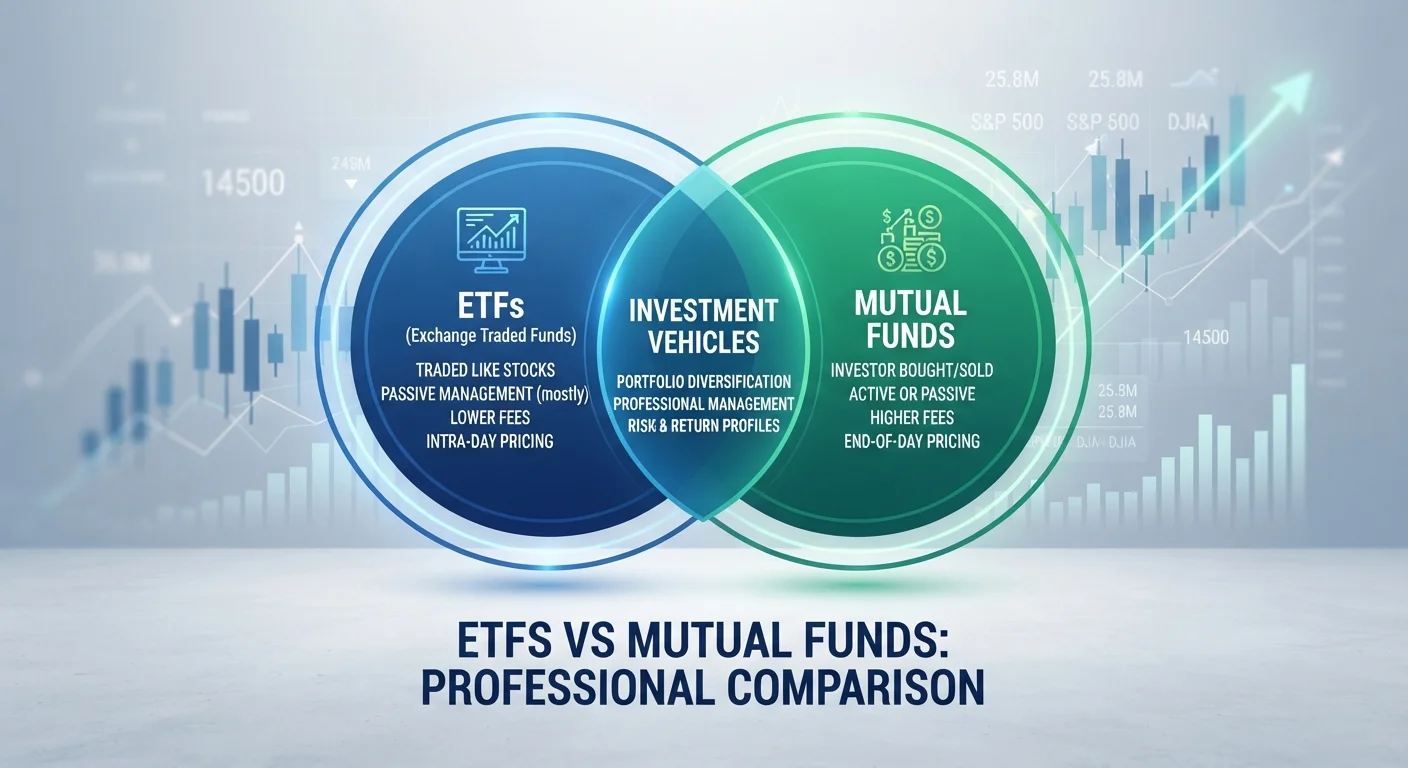
Photo credit: Wiseturt.com | Blogs Curated For You
In this article
ETFs and mutual funds both offer diversification, but they trade, price, and distribute gains differently. Here's what those distinctions mean in practice.
Key Takeaways
- ETFs trade on exchanges throughout the day like stocks; mutual funds price once daily after market close.
- Mutual funds can be bought in fractional dollar amounts; most ETFs require purchasing whole shares.
- ETFs tend to generate fewer taxable capital gains distributions than actively managed mutual funds.
- Both vehicles offer diversification, but their cost structures, tax behavior, and minimum investments differ meaningfully.
- Neither option is universally superior - the right fit depends on your account type, investing habits, and goals.
The Core Structural Difference
At their core, both ETFs (exchange-traded funds) and mutual funds are pooled investment vehicles - they collect money from many investors and use it to buy a basket of securities such as stocks or bonds. That shared purpose makes them easy to confuse. But the way each is structured has real downstream effects on how you buy them, what you pay, and how they're taxed.
A mutual fund is bought and sold directly through a fund company or brokerage, and its price - called the NAV - is calculated once per day after the market closes. You place an order during the day, but you won't know the exact price until after 4 p.m. Eastern Time.
An ETF, by contrast, trades on a stock exchange throughout the day, just like an individual stock. Its price fluctuates in real time based on supply and demand. You can buy or sell at any moment the market is open, and you'll see the current price before you execute the trade.
To understand how these differences connect to broader portfolio strategy, see our overview of what each asset class actually does in a portfolio.
Costs, Minimums, and How You Buy
Cost is one of the most consequential differences between these two structures. Here's how they compare across the factors that matter most to everyday investors.
| ETFs | Mutual Funds | |
|---|---|---|
| Trading | Intraday on stock exchanges | Once daily at market close (NAV) |
| Pricing | Real-time market price | End-of-day NAV only |
| Purchase increments | By share (fractional at some brokers) | By dollar amount |
| Typical minimum investment | Price of one share (often low) | Often $500-$3,000+ |
| Expense ratios (index-based) | Generally low (0.03%-0.20%) | Generally low (0.03%-0.20%) |
| Tax efficiency (taxable accounts) | Higher - fewer capital gains distributions | Lower - distributions passed to shareholders |
| Automatic investment plans | Limited at some brokerages | Widely supported in dollar amounts |
Mutual funds often have minimum initial investments - commonly $1,000 or more, though some funds set lower thresholds for tax-advantaged accounts like IRAs. ETFs, by contrast, can be purchased one share at a time, and some brokerages now offer fractional ETF shares, further lowering the barrier to entry.
Both vehicles carry an expense ratio - an annual fee expressed as a percentage of your investment that covers the fund's operating costs. Index-based versions of each tend to have lower expense ratios than actively managed counterparts. For a deeper look at how these fees accumulate over time, see our article on investment fees that quietly erode your returns.
Automating Contributions? Check Your Options
If you want to invest a fixed dollar amount on a regular schedule - say, $200 per month - mutual funds typically make this easier because you can invest in exact dollar amounts. Many brokerages support automatic mutual fund purchases. With ETFs, you may need fractional share support from your brokerage to replicate the same experience. Check what your platform offers before deciding which structure fits your contribution style.
Tax Behavior: Where ETFs Often Have an Edge
In a taxable brokerage account, how a fund handles capital gains distributions can significantly affect your annual tax bill - even if you haven't sold any shares yourself.
Mutual funds are legally required to pass realized capital gains through to shareholders at least once a year. When a fund manager sells securities inside the fund for a profit - whether to rebalance or meet redemptions from other investors - those gains are distributed to all shareholders. You owe taxes on that distribution regardless of whether you chose to reinvest it.
ETFs sidestep much of this through a mechanism called the creation/redemption process, in which authorized institutional participants exchange baskets of securities rather than cash. This structure generally allows ETFs to avoid triggering taxable capital gains internally, making them more tax-efficient in taxable accounts.
That said, if you sell your ETF shares at a profit, you still owe capital gains tax - the difference is that the event is triggered by your decision, not the fund manager's. For guidance on how account type interacts with these tax rules, see our comparison of taxable vs. tax-advantaged accounts.
~90%
Active funds underperforming their index over 20 years
According to the S&P Dow Jones Indices SPIVA U.S. Scorecard, roughly 90% of actively managed large-cap U.S. funds underperformed the S&P 500 over a 20-year period.
$9T+
Total U.S. ETF assets under management
U.S. ETF assets have grown to exceed $9 trillion, reflecting a broad shift toward lower-cost, exchange-traded investment structures among retail and institutional investors.
Active vs. Passive Management Within Each Structure
It's worth separating the structure question from the strategy question. Both ETFs and mutual funds can be either passively managed (tracking an index like the S&P 500) or actively managed (with a portfolio manager making buy/sell decisions).
Historically, the vast majority of ETFs have been index-based, while mutual funds have a longer tradition of active management - though index mutual funds have grown substantially in popularity. Active management typically comes with higher expense ratios and doesn't guarantee outperformance; most actively managed funds have underperformed their benchmark indexes over long periods, according to data from the SPIVA Scorecard published by S&P Dow Jones Indices.
For a side-by-side look at how index and actively managed approaches compare on cost and historical performance, see our article on index funds vs. actively managed funds.
Both structures can support a well-diversified portfolio. If you're still building your understanding of why diversification matters, our piece on diversification explained is a useful next step.
This article is for general informational and educational purposes only and does not constitute personalized investment, tax, or financial advice. Consult a qualified financial adviser or tax professional regarding your specific circumstances. All investing involves risk, including the possible loss of principal. Past performance does not guarantee future results.

Author
Investment & Insurance Editorial Team
Investment & Insurance Editorial Team is the collective byline for our editorial team and contributor network. Articles published under this byline or an editorial pen name are researched, written, and reviewed according to our editorial standards for clarity, consistency, and independence before publication.
View all articles →