
Index Funds vs. Actively Managed Funds
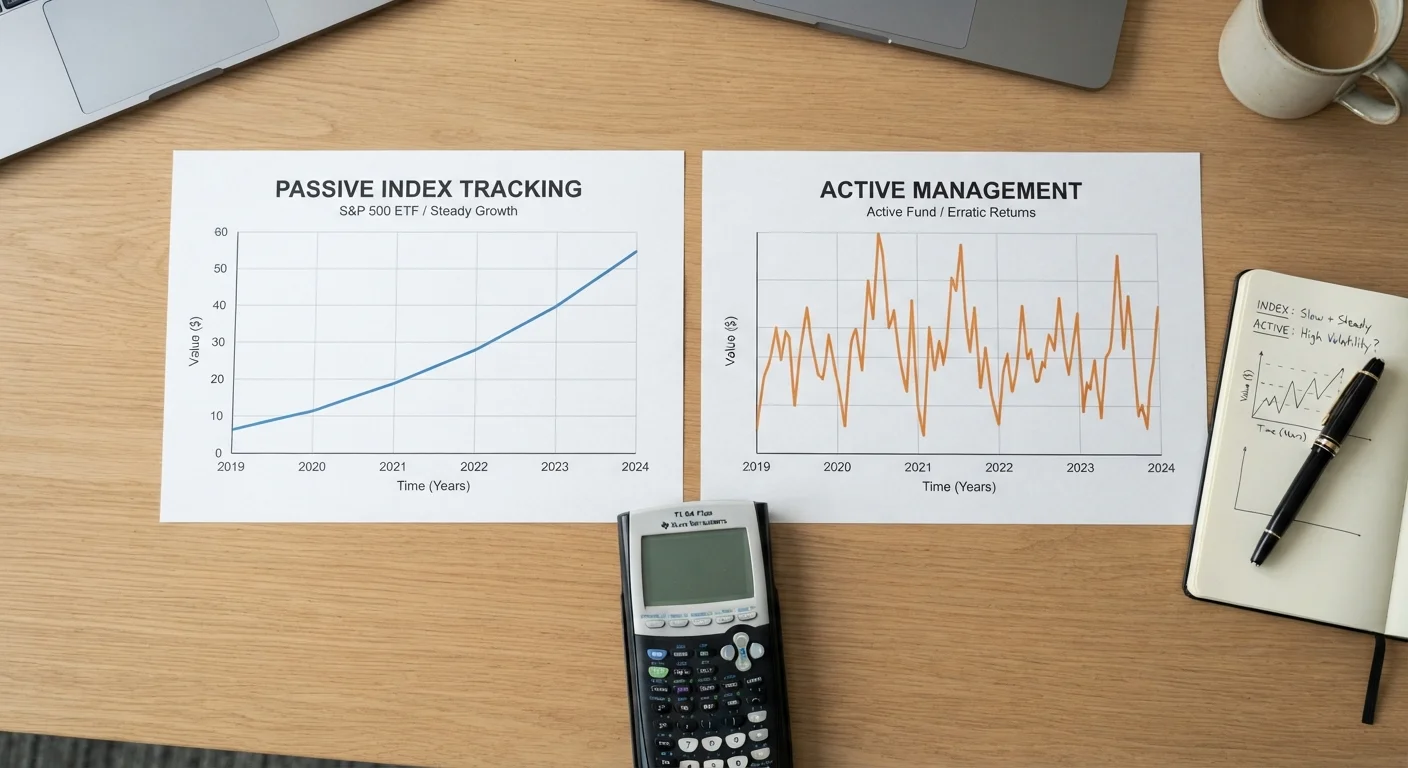
Photo credit: Wiseturt.com | Blogs Curated For You
In this article
See how index funds and actively managed funds differ in cost, strategy, and historical performance—without the jargon.
Key Takeaways
- Index funds passively track a market benchmark and typically carry significantly lower fees than actively managed funds.
- Actively managed funds employ portfolio managers who select securities in an effort to outperform the market.
- Research consistently shows most actively managed funds underperform their benchmark index over the long run, net of fees.
- Your investment time horizon, cost sensitivity, and goals should guide which approach - or blend - makes sense for you.
- Neither fund type guarantees returns; all investing involves risk of loss.
What Each Fund Type Actually Does
An index fund is designed to replicate the composition and performance of a specific market index - such as the S&P 500 or the Russell 2000. Instead of a manager choosing which securities to hold, the fund simply mirrors the index's holdings in the same proportions. Because there is little active decision-making, the operating costs stay low.
An actively managed fund, by contrast, employs a portfolio manager (or team) who researches, selects, and trades securities with the explicit goal of outperforming a market benchmark. This research-intensive process requires more staff, more transactions, and more operational overhead - all of which flows through to investors as higher fees.
Both types can be structured as mutual funds or ETFs (exchange-traded funds). If you want to understand how those vehicles differ from each other, see our overview of how ETF and mutual fund structures shape your investing experience. For a broader foundation, personal investing from the ground up covers the essential concepts before you choose any fund type.
The Cost Gap: Why Fees Matter More Than They Seem
The most concrete difference between these two approaches is cost. Index funds carry expense ratios - the annual percentage of assets charged for fund operations - that are typically well under 0.20%. Many broad-market index funds charge between 0.03% and 0.10% annually. Actively managed funds commonly charge 0.50% to 1.00% or more, and some specialty funds charge higher still.
That gap may sound small, but compounded over decades, even a 0.50% difference in annual fees can meaningfully reduce a portfolio's ending value. Our editorial piece on investment fees that quietly erode your returns breaks down exactly how expense ratios, trading commissions, and advisory charges compound over time.
| Criterion | Index Funds | Actively Managed Funds |
|---|---|---|
| Management style | Passive - tracks an index | Active - manager selects securities |
| Typical expense ratio | 0.03%-0.20% | 0.50%-1.00%+ |
| Goal | Match benchmark performance | Outperform benchmark |
| Portfolio turnover | Low | Generally higher |
| Tax efficiency (taxable accounts) | Generally higher | Generally lower |
| Manager risk | Minimal | Present - depends on manager skill |
| Long-run benchmark outperformance rate | Matches benchmark by design | Majority underperform after fees (per SPIVA data) |
Active funds also tend to trade more frequently, which can generate taxable capital gains distributions in taxable accounts - an additional cost that index funds, with their low turnover, largely avoid.
This article is for general informational and educational purposes only and does not constitute personalised financial or investment advice. Consult a licensed financial adviser before making investment decisions.
Performance: What the Long-Term Data Suggests
~85%
Large-cap active funds underperforming S&P 500 over 10 years
According to S&P Dow Jones Indices' SPIVA U.S. Scorecard, roughly 85% of large-cap active funds trailed the S&P 500 over a 10-year period in recent published reports.
0.03%
Lowest common index fund expense ratio
Broad-market index funds from several major fund providers have reached expense ratios as low as 0.03% annually, based on publicly available fund disclosures.
$50,000+
Estimated fee difference on $100K over 30 years
Illustrative calculation: a 0.80% annual fee difference compounded on a $100,000 portfolio over 30 years at a 6% gross return can reduce ending value by more than $50,000.
The S&P Indices Versus Active (SPIVA) scorecards, published by S&P Dow Jones Indices, have tracked actively managed fund performance against benchmarks for over two decades. Across most time horizons and fund categories, the majority of actively managed funds have underperformed their respective index benchmarks after fees are accounted for.
This does not mean active management never adds value. Some managers outperform their benchmarks over certain periods, and less-efficient market segments - such as small-cap stocks or emerging markets - have historically offered more scope for skilled active managers to find mispriced securities. The challenge for investors is identifying outperforming managers in advance, which research suggests is difficult to do consistently.
Past performance does not guarantee future results for either fund type. Market conditions, manager decisions, and economic cycles all introduce uncertainty. Understanding how different asset classes behave - covered in our article on stocks, bonds, and cash in a portfolio - helps put fund performance in broader context.
Choosing an Approach That Fits Your Situation
There is no universally correct answer. The right choice - or blend - depends on your goals, time horizon, cost tolerance, and how much complexity you want to manage.
Many investors use a core-satellite strategy: a large index-fund core for broad, low-cost market exposure, supplemented by smaller allocations to actively managed funds in areas where they believe active management may add value. This approach captures the efficiency of indexing while leaving room for tactical positions.
If you invest on a regular schedule regardless of market conditions, pairing index funds with a dollar-cost averaging strategy can reduce the emotional pressure of trying to time the market. Managing your broader budget - including how investment contributions fit alongside everyday expenses - is a foundation worth reviewing at Budget & Savings.
Whatever direction you consider, read the fund's prospectus, understand its expense ratio, and consult a qualified, licensed financial adviser who can evaluate your specific circumstances before making any investment decisions.

Author
Investment & Insurance Editorial Team
Investment & Insurance Editorial Team is the collective byline for our editorial team and contributor network. Articles published under this byline or an editorial pen name are researched, written, and reviewed according to our editorial standards for clarity, consistency, and independence before publication.
View all articles →