
Retail Price Anchoring: How Stores Use 'Original' Prices to Shape Your Perception
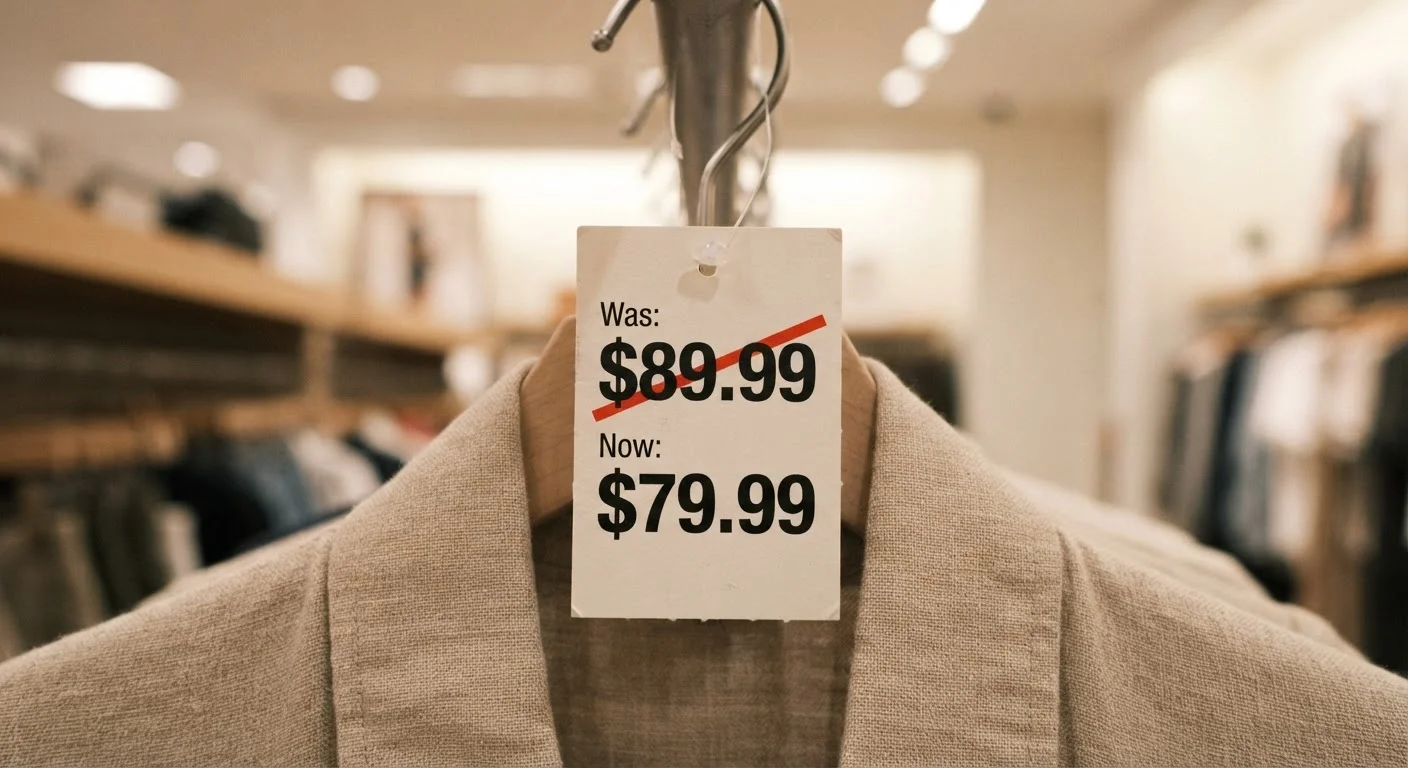
Photo credit: Wiseturt.com | Blogs Curated For You
In this article
Learn how retailers use anchor pricing to make discounts look bigger than they are — and how to see through the illusion.
Key Takeaways
- The 'original' price on a sale tag is not always the price anyone actually paid.
- Anchoring works by giving your brain a reference point - the first number seen influences all subsequent judgments.
- Inflated reference prices are a documented retail practice, not just occasional error.
- Price history tools let you verify whether a 'sale' represents a genuine drop.
- Comparing the item's current price across multiple retailers is more reliable than trusting the markdown shown.
- Awareness of anchoring reduces - but does not eliminate - its pull on purchasing decisions.
What the 'Original Price' Actually Represents
Walk through any department store or scroll a major retailer's website and you will encounter the same visual: a price in grey, crossed out, with a bolder, lower number beside it. That crossed-out figure is the anchor. Whether it is labeled 'regular,' 'original,' 'compare at,' or 'MSRP,' its job is the same - to set a reference point your brain uses to judge the deal below it.
The critical question is what that number actually reflects. In some cases it is a manufacturer's suggested retail price that few stores charge. In others it is a price the item held for only a brief window before a permanent markdown. In still others - particularly at outlet and fast-fashion retailers - it is a figure that was never charged in any meaningful quantity. The label looks authoritative, but the number behind it can be largely constructed.
This is not necessarily illegal in every instance, though US consumer protection guidelines from the Federal Trade Commission do require that advertised reference prices reflect genuine prior pricing. The gap between regulation and enforcement, however, is wide enough that inflated reference prices remain a routine tool in retail. Being part of the complete picture of pricing illusions means understanding that a crossed-out price is a claim - one that deserves scrutiny.
Why Your Brain Defaults to the Anchor
Anchoring is not a flaw in unsophisticated shoppers - it is a feature of how human cognition handles numerical comparisons. Research in behavioral economics has consistently shown that the first number presented in a decision context pulls subsequent judgments toward it, even when people know the number is arbitrary or unreliable.
In a retail environment, this means that a $60 jacket marked down from $120 feels meaningfully different from the same $60 jacket with no reference price at all - even though you are parting with the same amount of money either way. The anchor creates a sense of gain ('I'm saving $60') that is emotionally distinct from simply spending $60.
“The basic finding is that people estimate value by adjusting from an anchor. The anchor need not be accurate or even relevant - it still shapes the final judgment.”
— Daniel Kahneman, Nobel laureate in Economic Sciences, author of research on cognitive bias and decision-making
Retailers have decades of sales data confirming that anchored prices move more product than equivalent prices shown without reference points. The mechanism works across store formats, price tiers, and product categories - furniture, apparel, electronics, and groceries all see anchoring deployed routinely. Part of spending on your own terms is recognizing that the emotional 'win' of a markdown can be manufactured. Genuine savings require comparing the sale price to what other retailers actually charge today, not to a number printed in grey above it.
Spotting Anchoring in the Wild
Anchoring appears in several specific formats worth recognizing:
- 'Was / Now' labels: The most direct format. Check how long the item sat at the 'was' price - a one-day window before a permanent markdown is very different from a genuine seasonal reduction.
- 'Compare at' tags: Common in outlet and off-price retail. The reference often points to a full-price channel that rarely sells this specific item, or to a fictitious MSRP.
- Percentage-off banners: A '60% off' badge is compelling, but it is only meaningful if the base price was real. Calculate the actual dollar amount you would pay and compare it to other sources.
- Online strikethrough pricing: E-commerce platforms use the same visual language. Browser extensions that surface price history for a given product URL are among the most practical tools for cutting through this.
Use Price History Before You Decide
Free browser extensions for major e-commerce sites can show you a graph of price changes over 30, 90, or 180 days. If the 'sale' price has been the standard price for months, the anchor is doing all the persuasive work. Checking history takes under a minute and resets your reference point to actual data rather than the retailer's stated original price.
In physical stores, the anchor is fixed at the shelf. Online, it can be dynamic - some retailers adjust reference prices algorithmically based on traffic, browsing behavior, or time of day. This makes consistent cross-retailer comparison even more important when shopping online. For a direct comparison of how pricing works across channels, see In-Store Deals vs. Online Prices.
A Practical Framework for Evaluating Markdowns
Skepticism without a method is just friction. These steps convert doubt into actionable evaluation:
- Ignore the anchor first. Look at the sale price in isolation and ask whether you would pay that amount if no reference price existed.
- Check the price elsewhere. A quick search of the item's model number or product name across two or three retailers gives you a real market rate. If the 'sale' price is the standard price everywhere, the anchor is doing most of the work.
- Use price-history tools for online purchases. Several free tools track and display price changes over time for major e-commerce sites. A consistent price with a freshly added strikethrough is a clear signal.
- Separate the discount from the value. A 50% reduction on something you did not need is still spending, not saving. Why Your 'Great Deal' Sometimes Costs More in the Long Run covers how perceived savings can inflate total spending over time.
~33%
Average overstatement of reference prices in studied retail contexts
A 2014 analysis published in the Journal of Retailing found reference prices in promotional advertising were frequently set well above actual transaction prices, with considerable variation across product categories.
2x
Sales lift commonly attributed to anchored pricing versus unanchored
Retail pricing research has repeatedly found that displaying a reference price alongside a sale price significantly increases purchase rates compared to showing the sale price alone, even when the savings are identical.
Anchoring is one tactic inside a wider retail playbook. Understanding it alongside flash sales versus everyday low pricing gives a more complete view of which discount formats tend to reflect genuine price reductions versus manufactured urgency. Applying consistent evaluation habits - rather than reacting to each sale signal as it appears - is the foundation of smart budgeting over time.
Frequently Asked Questions

Author
Smart Shopping Editorial Team
Smart Shopping Editorial Team is the collective byline for our editorial team and contributor network. Articles published under this byline or an editorial pen name are researched, written, and reviewed according to our editorial standards for clarity, consistency, and independence before publication.
View all articles →